Data Directives (명령어)

Q. malloc (memory allocation)?
malloc은 C 및 C++ 프로그래밍 언어에서 메모리를 동적으로 할당하는 함수입니다. "malloc"은 "memory allocation"의 줄임말로, 프로그램 실행 중에 필요한 메모리 공간을 할당하는 데 사용됩니다. 메모리 할당은 데이터 구조를 생성하거나 가변 크기의 데이터를 저장하기 위해 매우 유용합니다.
malloc 함수는 특정 크기의 메모리 블록을 할당하고 그 블록의 시작 주소를 반환합니다. 이 할당된 메모리 블록은 프로그램이 사용되는 동안 유지되며, 사용이 끝나면 해제해야 합니다. 메모리 누수를 방지하기 위해 free 함수를 사용하여 할당된 메모리를 해제할 수 있습니다.
malloc 함수의 기본 원형은 다음과 같습니다:
void* malloc(size_t size);여기서 size는 할당하려는 바이트 수를 나타내며, 함수는 할당된 메모리 블록의 시작 주소를 void 포인터로 반환합니다.
예를 들어, 다음은 정수 10개를 저장할 수 있는 메모리 블록을 할당하고 해당 주소를 포인터에 저장하는 방법입니다:
int* myArray = (int*)malloc(10 * sizeof(int));
메모리를 할당한 후에는 필요한 작업을 수행한 후에 free 함수를 사용하여 해당 메모리를 해제해야 합니다. 메모리를 해제하지 않으면 메모리 누수가 발생할 수 있으며, 이는 프로그램의 성능에 영향을 미칠 수 있습니다.
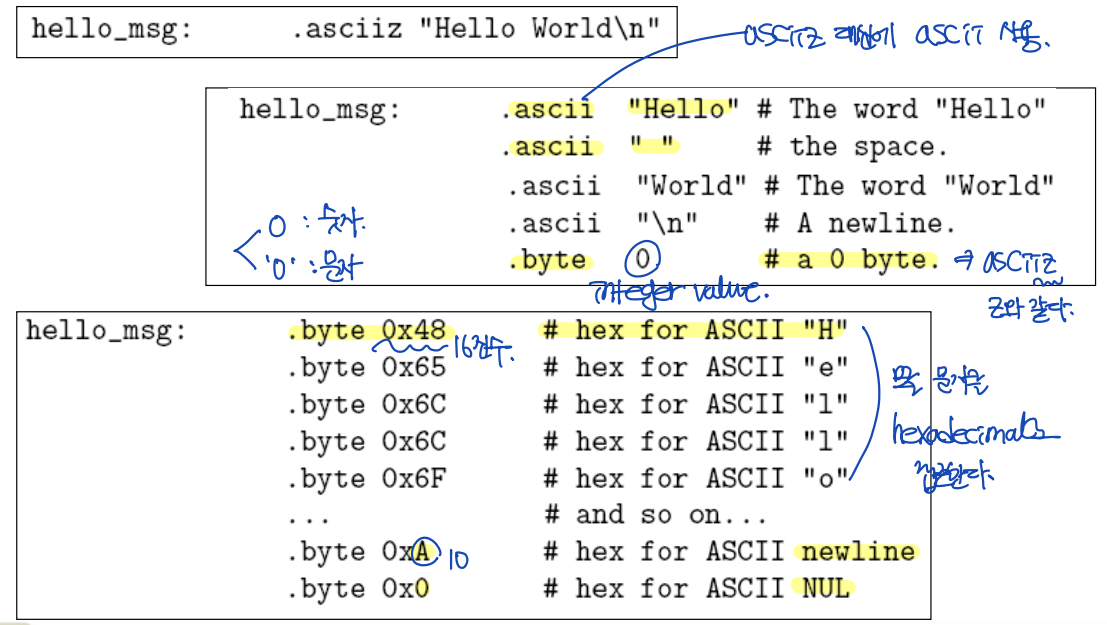
Example 3 - Hello World
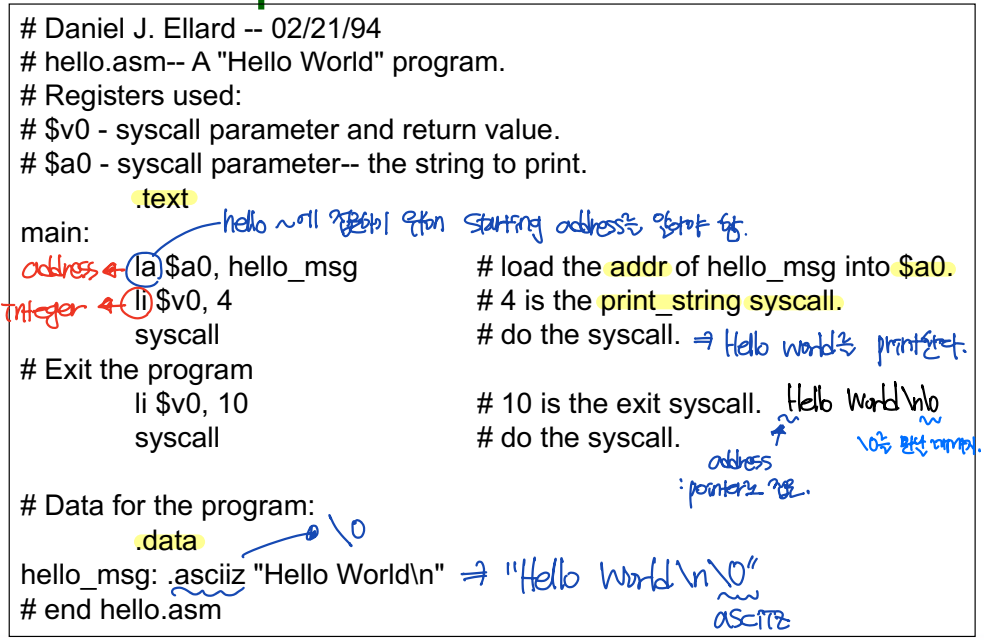
They are the same
Register Operands
▶ Arithmetic instruction: Use register operands.
▶ MIPS has a 32 x 32-bit register file.
- Register number: 0 ~ 31
- word: 4-byte (32-bit)
▶ Assembler names:
- $t0, $t1, ..., $t9: temporary values
- $s0, $s1, ..., $s7: saved values
Register Operand - Example
f = (g + h) - (i + j);

// f, ..., j in $s0, ..., $s4
▶ Compiled MIPS code:
- add $t0, $s1, $s2
- add $t1, $s3, $s4
- add $s0, $t0, $t1
Memory Operands
▶ To apply arithmetic operands:
- Load: memory --> register
- Store: register --> memory
▶ Memory is byte addressed.
▶ Words are aligned in memory.
- Address in memory: multiple of 4 (1 word = 4 bytes)
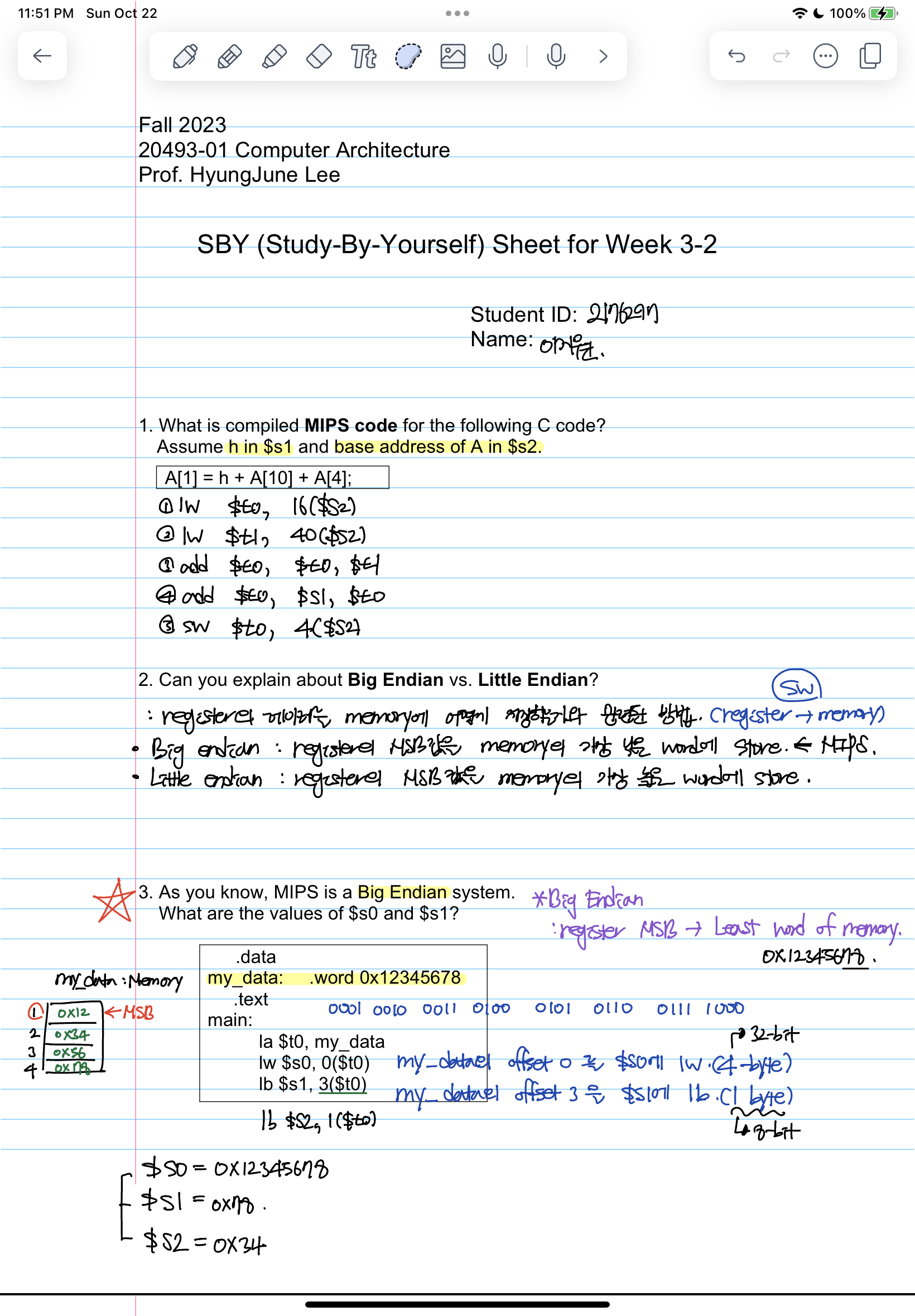
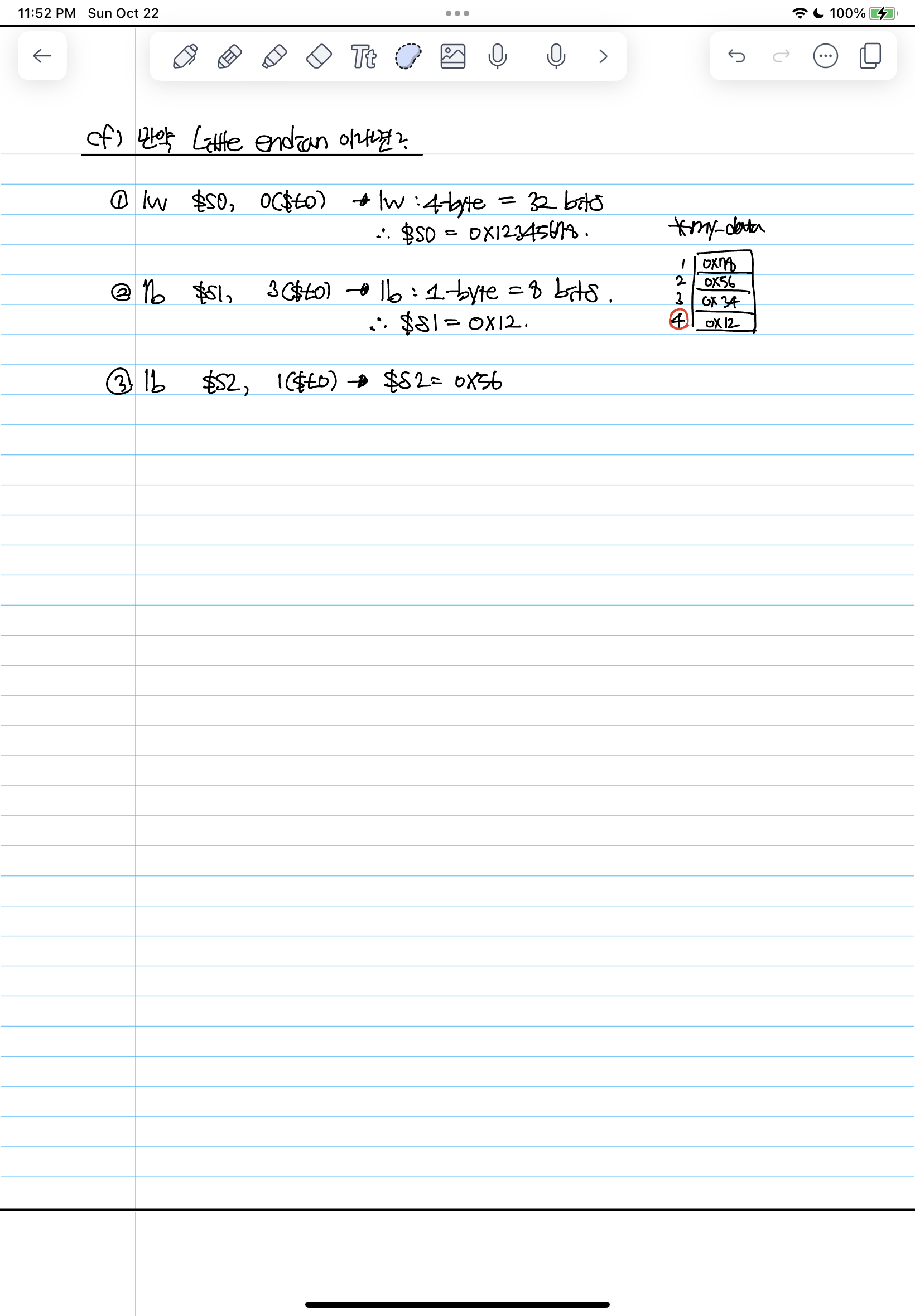
▶ MIPS is Big Endian
: MSB(Most Significant Byte) at least address of a word.
Big Endian vs. Little Endian
- Big Endian: MSB --> least address in memory.
- Little Endian: MSB --> largest address in memory.

Memory Operand - Example 1
g = h + A[8];

// g in $s1
// h in $s2
// base address of A in $s3
▶ Compiled MIPS code:
- lw $t0, 32($s3)
- add $s1, $s2, $t0
Memory Operand - Exampe 2
A[12] = h + A[8]

// h in $s2
// base address of A in $s3
▶ Compiled MIPS code:
- lw $t0, 32($s3)
- add $t0, $s2, $t0
- sw $t0, 48($s3)
Registers vs. Memory
- Registers are faster to access than memory.
- Operating on memory data requires loads and stores.
- Compiler must use registers for variables as much as possible.
Immediate Operands
- Constant data specified in an instruction.
- No subtract immediate instruction.
addi $s3, $s3, 4 // $s3 = $s3 + 4
The Constant Zero
- MIPS register 0($zero) is the constant 0.
--> Useful for common operations.
// Move between registers

add $t2, $s1, $zero   // $t2 = $s1 + 0
Unsigned Binary Integers

2s-Complement Signed Integers
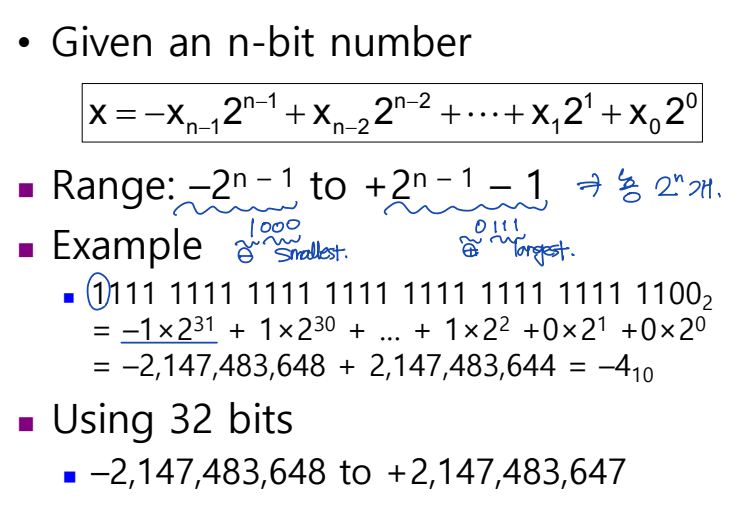
▶ Bit 31 is sign bit
- 1: -
- 0: +

Signed Negation (2의 보수법 계산 방법)
- 숫자 다 뒤집기
- +1
- 부호 붙이기
Sign Extension
- Unsigned: 앞에 0을 붙인다.
- Signed: 앞에 sign bit을 붙인다.
SBY 3-2
'Computer Architecture > 컴퓨터구조[01]' 카테고리의 다른 글
| [컴퓨터구조] 2. Instructions: Language of the Computer (5) (0) | 2023.09.27 |
|---|---|
| [컴퓨터구조] 2. Instructions: Language of the Computer (4) (1) | 2023.09.25 |
| [컴퓨터구조] 2. Instructions: Language of the Computer (2) (0) | 2023.09.18 |
| [컴퓨터구조] 2. Instructions: Language of the Computer (1) (0) | 2023.09.13 |
| [컴퓨터구조] 1. Computer Abstractions and Technology (3) (0) | 2023.09.13 |


